When you buy through links on our articles, Future and its syndication partners may earn a commission.

Astronomers have narrowed the search for extraterrestrial life from thousands of distant worlds down to just a few dozen promising candidate planets, offering a clearer roadmap for one of science's biggest questions: Are we alone?
In a new study, a team of researchers led by Lisa Kaltenegger of the Carl Sagan Institute at Cornell University identified 45 rocky exoplanets that sit within their stars' habitable zones, where temperatures could allow liquid water to exist on their surfaces. Out of more than 6,000 known exoplanets, these worlds represent some of the most compelling places to search for alien life.
The team used data from the European Space Agency's now-retired Gaia mission and the NASA Exoplanet Archive to refine estimates of how much stellar energy each planet receives — one of the key factors determining whether a world might be too hot, too cold or just right for life as we know it.

But rather than simply asking which planets might host life, the team set out to answer a deeper question: What are the limits of habitability? To do that, they deliberately included worlds that push the boundaries in their catalog.
"We know Earth is habitable, while Venus and Mars are not. We can use our solar system as a reference to search for exoplanets that receive stellar energy between what Venus and Mars get," study co-author Abigail Bohl said in a statement.
"Observing these planets can help us understand when habitability is lost, how much energy is too much and which planets remain habitable — or maybe never were," Bohl added.
The team also considered planets with elliptical orbits; further research here might determine how much such "orbital eccentricity" a planet can have before it loses its habitability.
Crucially, this new exoplanet catalog is not meant to be an exhaustive list of potentially habitable worlds. Instead, it serves as a strategy for future research. The team highlighted which planets are best suited for different observation techniques, helping guide powerful instruments like the James Webb Space Telescope and other observatories to probe for biosignatures, or potential signs of life.
"While it's hard to say what makes something more likely to have life, identifying where to look is the first key step — so the goal of our project was to say, 'Here are the best targets for observation'," said co-author Gillis Lowry, who is now a graduate student at San Francisco State University.
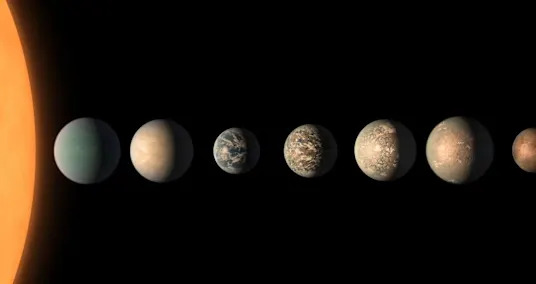
Among the most compelling targets is the TRAPPIST-1 system, about 40 light-years away, which hosts multiple potentially habitable Earth-size rocky planets. Interestingly, these worlds may be tidally locked to their star, with permanent day and night sides. Still, Trappist-1 e is considered one of the leading candidates to host liquid water.
Another standout is LHS 1140 b, a denser, larger world considered a "super-Earth" about 48 light-years away. With a mass more than five times that of Earth and slightly higher overall density, it could be a water-rich ocean world.
Closer to home, Proxima Centauri b, orbiting our nearest stellar neighbor just 4.25 light-years away, remains tantalizing to astronomers, despite concerns about intense stellar flares that could strip away its atmosphere.
With next-generation observatories coming online, future observations of these 45 worlds may bring scientists closer than ever to determining whether life exists beyond Earth.
A study on the research was published in the Monthly Notices of the Royal Astronomical Society on March 19.
LATEST POSTS
- 1
 10 times the sky amazed us in 2025
 - 2The most effective method to Decide the Best Auto Crash Attorney for Your Lawful Necessities
- 3Figure out How to Use Your Nursing Abilities for Better Compensation
- 4The most effective method to Help a Friend or family member Determined to have Cellular breakdown in the lungs
- 5Charli xcx teases new film ‘The Moment’: What to know about the A24 movie


- Step by step instructions to Protect Your Speculations with Cd Rates
- Muslim nations condemn new Israeli death penalty law
- 5 Movies That Leaving an Imprint with Inventive Innovation
- 'War is not over': Detailed diagrams of prisons found in cells of Oct. 7 terrorists
- Anti-war protests held across Israel under wartime gathering limits
- Triumph's 400 Range Has Just Changed In India, And Here's Why
- Overlooked infertility care should be part of national health services, says WHO
- Holyvolt And Wildcat Could Help The West Reclaim Battery Leadership
- Transcript: NASA's Jared Isaacman on "Face the Nation with Margaret Brennan," April 5, 2026