When you buy through links on our articles, Future and its syndication partners may earn a commission.

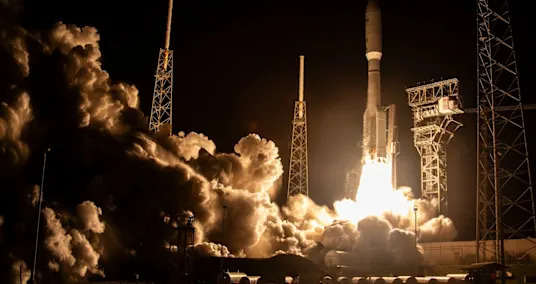
A United Launch Alliance (ULA) Atlas V rocket will launch its heaviest-ever payload on Saturday morning (April 4), and you can watch the action live.
The Atlas V is scheduled to lift off Saturday at 1:45 a.m. EDT (0545 GMT) from Florida's Cape Canaveral Space Force Station, carrying 29 satellites for the Amazon Leo broadband constellation to orbit. Together, those spacecraft weigh 18 tons, according to ULA.
You can watch it live here at Space.com, courtesy of ULA, or directly via the company. Coverage will begin 20 minutes before launch.

The Amazon Leo megaconstellation, previously known as Project Kuiper, will eventually consist of about 3,200 satellites in low Earth orbit. It's Amazon's answer to SpaceX's Starlink network, which beams internet service down from more than 10,000 satellites (and counting).
Amazon Leo is still in its early stages; just 212 of the spacecraft have reached orbit to date over the course of eight launches (not counting a 2023 liftoff that sent up two prototype satellites).
The Atlas V has flown four of those operational missions. Three employed SpaceX's Falcon 9, and the other one used Arianespace's Ariane 6 heavy lifter.
Saturday's launch, which Amazon calls LA-05, will be the first Atlas V mission to loft 29 Amazon Leo satellites; the others carried 27 of the spacecraft.
"The increase is a result of detailed engineering work between Amazon Leo and ULA, and is made possible by a new, higher-performing version of the RL10C engine used on the rocket's Centaur upper stage," Amazon representatives wrote in a mission description. "While the engine has flown on previous missions, LA-05 marks the first time the program has completed the extensive engineering and safety analysis required to use it with our larger payload."
And that payload is larger in a significant way, according to the LA-05 mission description: "With 29 satellites aboard, LA-05 will mark the heaviest payload ever flown on an Atlas V."
LATEST POSTS
- 1
 Who is Artemis? Meet the Greek goddess who inspired NASA's return to the moon
 - 2German petrol stations hike prices as once-a-day rule takes effect
- 3Two reportedly killed as Israel attacks Hezbollah targets in Lebanon
- 4Indian Health Service is digging out of decades-old construction backlog for medical buildings
- 5ONE returns to Red Sea with new service





- My Excursion to a Better Way of life: Health Experiences
- No more attempts to free whale stranded off Germany, officials say
- Former ‘Dancing with the Stars’ Pro Survives Plane Crash at LaGuardia That Left 2 Pilots Dead
- 9 Under-The-Radar Malaysian Islands To Consider Instead Of Thailand Or Indonesia
- Merck urges science-led US vaccine schedule after CDC trims childhood vaccine list
- At least 55 injured in Russia after train crashes, overturns
- Which Switch Game Do You Suggest? Share Your Decision
- Cocoa Prices Sink on Favorable Crop Conditions in West Africa
- The moon and sun figure big in the new year's lineup of cosmic wonders