Travelers are often attracted by the allure of seeing Canada's wildlife up close. The country hosts animals as diverse as the elusive narwhal, mighty moose, and majestic cloud wolf. It's also home to three ursine species: the grizzly bear, black bear, and polar bear. Indeed, from Nanuk, a remote ecolodge where you can see polar bears in Manitoba's wilderness, to Fawn Bluff, a once-in-a-lifetime luxury retreat offering grizzly bear sightings, Canada has long been a top destination for viewing these solitary creatures. But did you know that, across the nation's 10 provinces and three northern territories, one is entirely bear-free? An eastern maritime province in the country's Atlantic region, Prince Edward Island (PEI), is the smallest of the Canadian provinces and territories. What it lacks in space, it certainly makes up for in its tourism offerings, with gloriously fresh, high-quality seafood, dramatic rust-red beaches and cliffs, and various opportunities to experience Indigenous culture. Unfortunately, while you'll find wildlife like coyotes, beavers, Canada geese, and bald eagles, you won't find any bears.
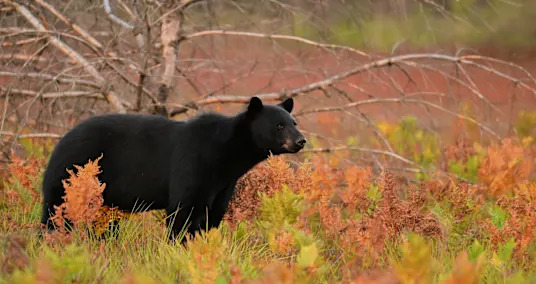
Surprisingly, black bears used to have habitat on the island, along with caribou, deer, and Canada lynx — all animals that have sadly long been extirpated from PEI. These bears once wandered the old-growth forests of this 2,170-square-mile island, feeding off berries, grasses, plants, insects, and small animals. The last one was recorded as killed in 1927 by a local hunting family, although there was a possibly credible sighting in 1935. People claimed to have seen others (with no documented evidence) well into the 1950s. Either way, the entire bear population is now gone, disappearing due to a number of factors that include the clearing of land, loss of habitat, and over-hunting.
Read more: 5 Abandoned National Parks And Monuments That No Longer Exist
The history of bears on Prince Edward Island

Stories abound of island settlers being terrorized — and even eaten — by black bears in the 1700s. Reportedly, bears used to chase students on their way to school and attack villagers walking through the woods, wreaking havoc on townspeople. In turn, they would shoot the animals to protect themselves and their livestock. Their meat was also lucrative and highly sought after in the early 1800s, as was their oil and skin. Although these tenacious black bears surely posed a threat to the human and animal residents of this province, their complete extinction from Prince Edward Island was tragic.
If you're planning to spend time outdoors in PEI's natural beauty, there will still be plenty of non-ursine wildlife for you to see — and, luckily, you won't need to learn how to properly bear-proof your campsite. Along the pleasant hiking trails of Prince Edward Island National Park, keep your eyes open for curious red foxes, snowshoe hare, and eastern chipmunks. Or head further east to North Lake Harbour, where you can spot pilot whales, porpoises, and dolphins on a thrilling whale-watching expedition.
The best time of year to visit PEI is July and August, for sun-filled days and longer opening hours for attractions. June and September, the shoulder months, are good options for fewer crowds, gorgeous scenery, and excellent food. To reach the island, you can fly into the international airport (YYG) in Charlottetown, a storybook town full of charming, family-friendly events and the official provincial capital. There are year-round flights here from major Canadian hubs, including Montréal, Ottawa, and Toronto.
Ready to discover more hidden gems and expert travel tips? Subscribe to our free newsletter and add us as a preferred search source for access to the world's best-kept travel secrets.
Read the original article on Islands.
LATEST POSTS
- 1
 Instructions to Plan for Your Teeth Substitution Methodology
 - 2Putin says Russian forces will seize capital of Zaporizhzhya
- 3AfD in Brandenburg takes back suit against the intelligence service
- 4Chicago reports first rabies-positive dog in 61 years. What we know.
- 5NASA set to launch Artemis 2 moon mission today, the 1st crewed lunar flight since 1972



- U.S. overhauls childhood vaccine schedule, recommends fewer shots
- US measles cases surpass 2,000, highest in 30 years: CDC
- Find the Excellence of Old style Expressive dance: Encountering the Effortlessness and Polish of Dance
- Inflammatory Merz remarks on migrants' violence against women slammed
- To fix a patient's irregular heartbeat, doctors first tested its digital 'twin'
- Top Music and Dance Celebration: Which One Gets You Going?
- Global measles cases drop 71% in 24 years as vaccination coverage improves, WHO says
- 'No middle ground' for tackling antisemitism after Bondi Beach mass shooting, deputy FM Haskel says
- Council removes proposal to rename park named after former president of Israel