CAPE CANAVERAL, Fla. — Toilet plumbing problems, email glitches and issues phoning home: Astronauts are just like us!
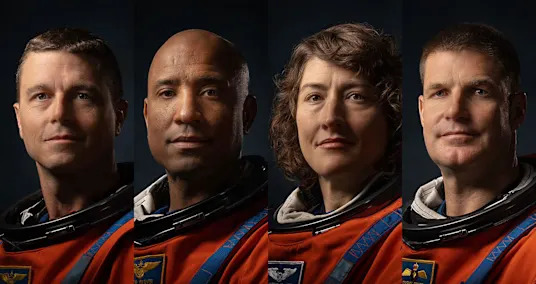
The four crew members who launched Wednesday on NASA's 10-day Artemis II mission around the moon have already overcome several challenges during their first day in space.
Shortly after they reached orbit around Earth, the crew members — NASA astronauts Reid Wiseman, Christina Koch and Victor Glover and Canadian astronaut Jeremy Hansen — experienced a “loss of communications” with ground controllers. During the brief dropout, NASA was unable to receive data from the crew members or their Orion spacecraft. The astronauts seemed to be able to hear Mission Control, but not the other way around.
The issue was resolved quickly, and NASA officials said ground teams are investigating what caused the glitch.
“There were no issues with the vehicle itself,” NASA Administrator Jared Isaacman said Wednesday at a post-launch news briefing. “Comms with the crew have been restored. We’re actively working the issue.”
The crew members also reported a blinking fault light while they tested their onboard toilet Wednesday.
Called the Universal Waste Management System, the toilet on the Orion capsule is designed to vent urine overboard and store feces until the crew's return. It is separated by a door on the capsule's floor to allow some privacy. A similar toilet has been tested on the International Space Station.
Mission managers worked with the astronauts to assess the problem overnight, and NASA confirmed early Thursday that the crew was able to restore the space toilet to normal operations.
Had it not been fixed, the backup plan was for the crew to use what NASA calls "collapsible contingency urinals" to collect urine in bags. The toilet would still have been used for fecal collection.

A third issue that cropped up may feel the most relatable to many people on Earth: While the astronauts were setting up their computers, they requested tech support from Mission Control. The culprit? Microsoft Outlook.
“I also see that I have two Microsoft Outlooks, and neither one of those are working,” Wiseman, the mission’s commander, radioed to the ground.
Mission controllers were eventually able to gain remote access to the computers and bring Outlook back online for the astronauts.

With early glitches solved, the Artemis II astronauts completed a major milestone Thursday evening: a key engine burn that put them on a trajectory to fly around the moon.
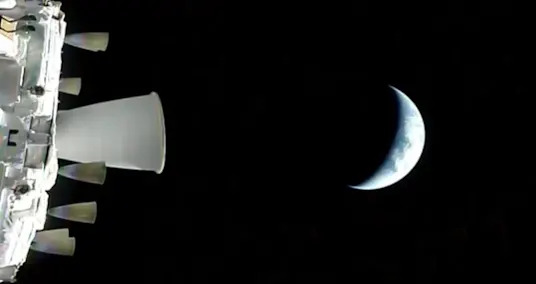
The maneuver, known as a translunar injection burn, lasted just under six minutes. Orion's main engine fired, boosting the capsule’s velocity enough to send it out of Earth orbit.
The crew is “now on trajectory to fly around the moon for the first time in 50 years,” Mission Control said after the burn was complete.

It was the last engine burn of that magnitude on the Artemis II mission, since the spacecraft's path relies heavily on the gravitational pulls of Earth and the moon. Now that the translunar injection is complete, the astronauts are on an irreversible journey around the moon.
The burn came after the astronauts got some sleep Thursday, with their wakeup call coming at 2:35 p.m. ET. They awoke to the song “Green Light” by John Legend and messages from NASA employees and members of the teams that helped them get to space. Glover thanked them for the kind words.
Roughly a couple of hours after that, mission managers in Houston met to decide whether to go through with the translunar injection burn.
The team polled “go.”
This article was originally published on NBCNews.com
LATEST POSTS
- 1
 Netflix’s Price Hikes Just Got Rejected by an Italian Court. Here’s Why It Matters Everywhere
 - 2What’s your chronotype? Knowing whether you’re a night owl or an early bird could help you do better on tests and avoid scams
- 3Unfathomable and Entertaining Legal disputes That Surprise everyone
- 4How to watch NASA's Artemis 2 astronauts launch to the moon on April 1
- 52024's Hot Games: Must-Play Titles of the Year




- These four astronauts could soon travel farther from Earth than anyone has gone before
- Move. Cheer. Dance. Do the wave. How to tap into the collective joy of 'we mode'
- Smartwatches: Remain Associated and Dynamic
- Manageable Living: Eco-Accommodating Decisions for Regular day to day existence
- Flu activity rises sharply across US with 7.5 million cases, CDC data shows
- Israeli strikes on Beirut, as Hezbollah and Iran attack Israel
- UN chief calls on Yemen's Houthi rebels to free all UN detainees
- Figure out How to Track the Establishment of New 5G Pinnacles
- Israel reports killing another senior Iranian oil official